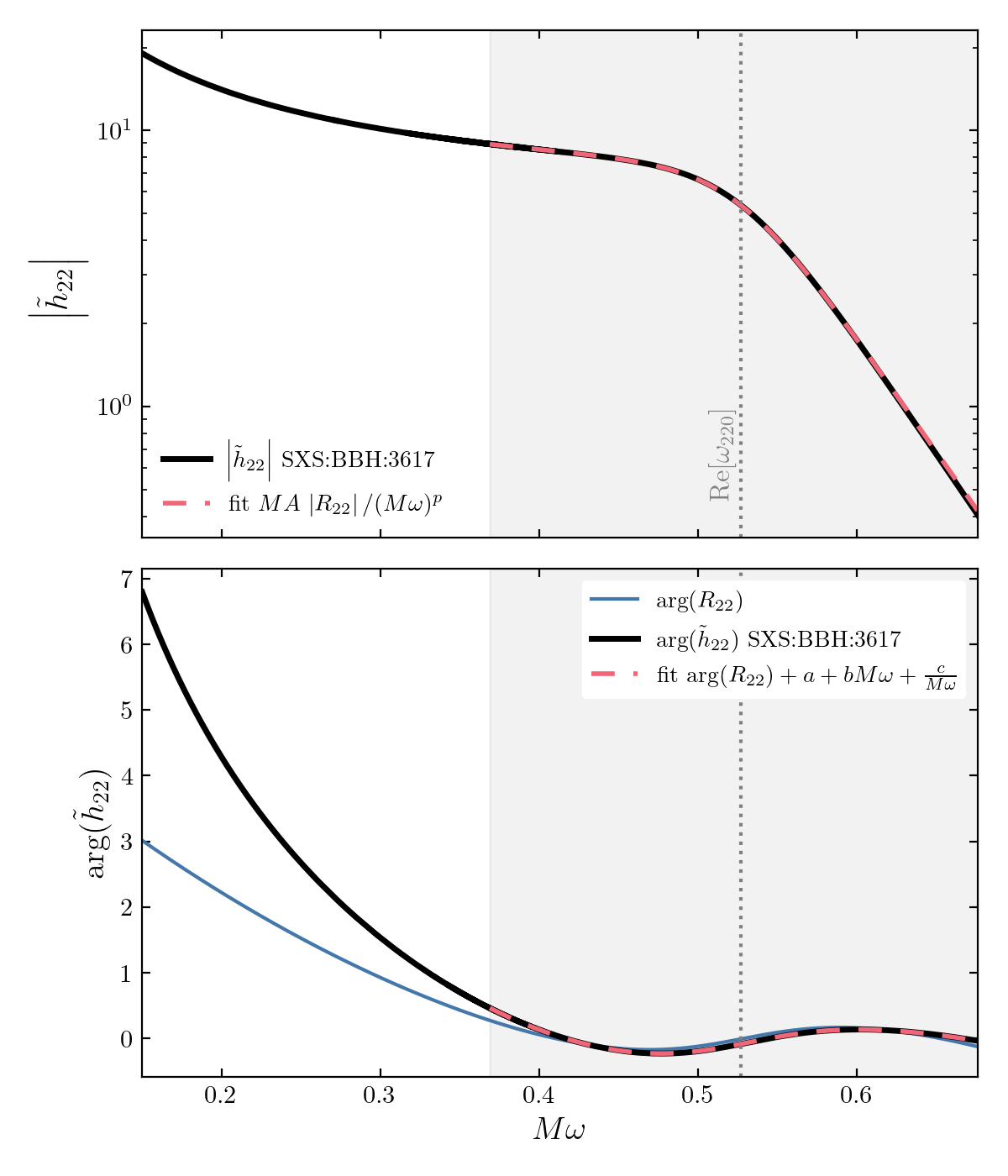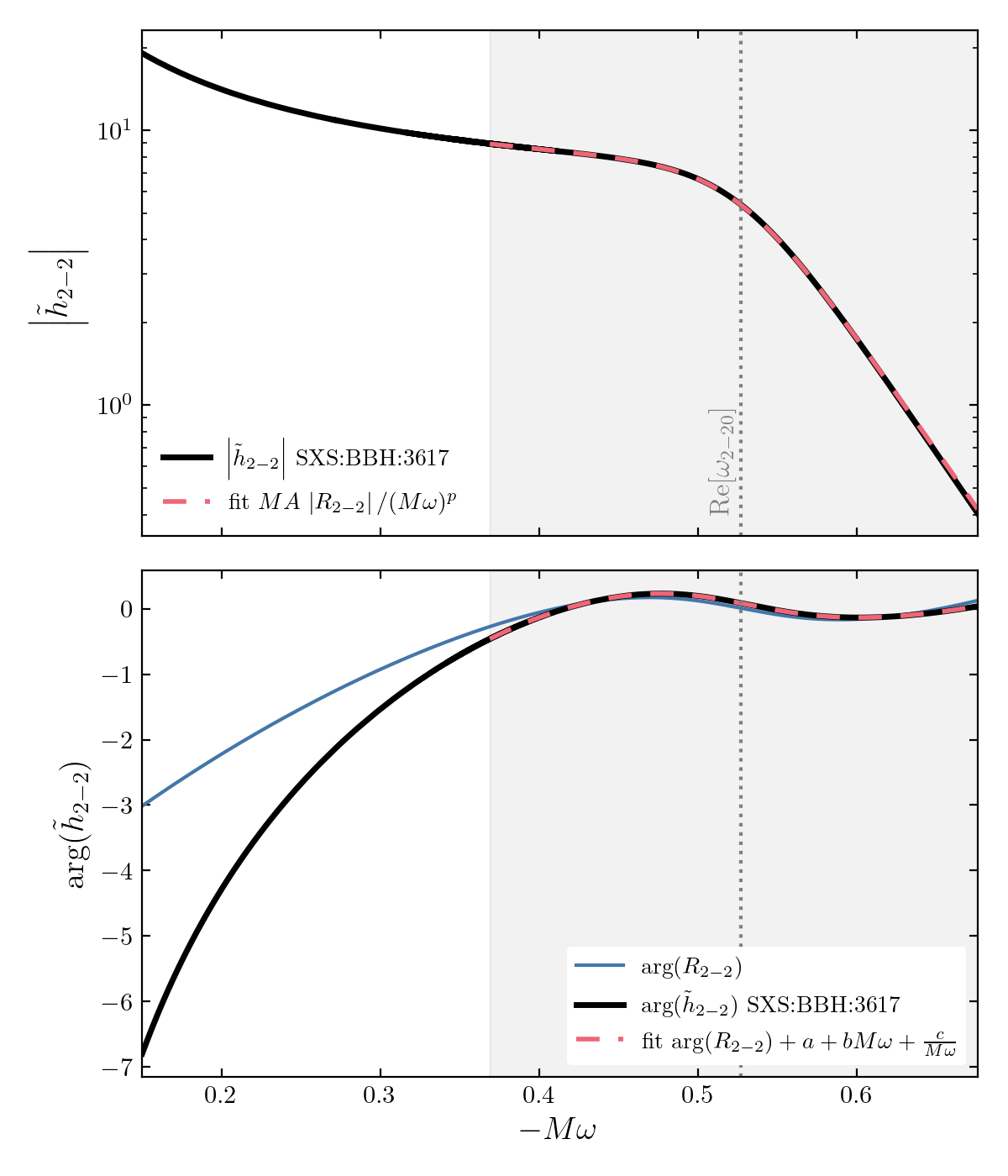
SXS fit example
This example fits the GreyRing model directly to a numerical-relativity waveform from the SXS catalog.
The user selects an SXS simulation and a multipole (ℓ, m). The code extracts the corresponding waveform mode, builds the frequency-domain spectrum, fits the GreyRing amplitude and phase, and computes the mismatch.
Folder
examples/sxs_fit/
Typical structure:
examples/sxs_fit/
  run.py
  theory/
    dataAbs22.txt
    dataPhase22.txt
Theory files
The example requires two theory files:
dataAbs22.txt
dataPhase22.txt
They contain the absolute value and phase of the complex reflectivity for the (l, m)=(2,2) mode.
Each file should contain a Python-style array named:
ZedSIM = [...]
with comma-separated entries. Here SIM is the SXS simulation ID. For example, for SXS:BBH:3617, the expected array name is:
Zed3617 = [...]
The length of this array must match the omega_theory array passed to gr.fit.
At the moment, the example can be tested for multipoles up to ℓ = 4. For negative-m modes, compute the reflectivity for the corresponding positive-m mode. The code expects the theory file label to use the positive-m convention. For example, a fit of the (2, -2) mode uses theory files labelled as (2, 2).
See Theory files for more details.
Minimal usage
import numpy as np
import greyring as gr

omega_theory = np.linspace(0.001, 1.2, 1200)

result = gr.fit(
    sim_number=3617,
    ell=2,
    m=2,
    abs_file="theory/dataAbs22.txt",
    phase_file="theory/dataPhase22.txt",
    omega_theory=omega_theory,
    omega_i_factor=0.7,
    omega_f_amp_ratio=20.0,
    make_plot=True,
)

print(result.A)
print(result.p)
print(result.c)
print(result.mismatch)
Main inputs
| Parameter | Meaning |
|---|---|
sim_number |
SXS simulation number |
ell, m |
waveform multipole |
abs_file |
reflectivity absolute-value file |
phase_file |
reflectivity phase file |
omega_theory |
frequency array corresponding to the reflectivity arrays |
omega_i_factor |
lower edge of the fitting window, relative to the knee frequency |
omega_f_amp_ratio |
upper edge of the fitting window, set by the amplitude-drop criterion |
make_plot |
save a diagnostic plot |
Fit window
The lower edge is defined as
omega_i = omega_i_factor * omega_x
where omega_x is the knee frequency.
The upper edge is selected from
|h(omega_f)| = |h(omega_x)| / omega_f_amp_ratio
The default choice is
omega_i_factor = 0.7
omega_f_amp_ratio = 20.0
See details in the paper.
Example figures
Example diagnostic plots for the (2, 2) and (2, -2) modes are included in the example folder.